June 24 // carnie carne and prune jews
Heat is subjective. Heat is subjective. There is no air conditioning in this country and France is long and the spikes of wheat growing along the highway are hard and sharp and WHY IS THERE NEVER ANYWHERE TO ACTUALLY EAT?
The roads are starting to incline ever-so-slightly and the water in my squeeze bottles is always warm and never quenching. Hold it, Mark, I need to pull off at the side of the road here and pop some prunes1 into ma bouche. Though I’m pretty sure these aren’t the local quetsche, sucking the juice right off the bone, rolling around the bitter pit along my bleeding gums so the sour crust gets my glands salivating.
We are going to need to discuss our options, Mark, as we’ve been biking for 25 miles, with 20 more to go, and it’s already past noon. Despite rolling through the dairylands in the shadow of the village of Langres, which lends its name to one of the most certifiably orange stankcheeses in all of France, there’s nary a bistro, boucherie, or boudoir in sight.
“But wait!,” I say, staring at the map on my phone as Mark slows to my speed. “What about this place? It looks like there’s a pond. Maybe we can get a sandwich and go for a swim amongst the beautiful milkmaids who are there for their mid-day cool-down?”
Mark’s not convinced. “It’s pretty far off the main road, man,” he says, as I bust ass on my bike just to keep up the conversation. “I thought you didn’t want to detour anymore.”
“That was in wine country, with all the hills. And we gotta eat.”
“You’re the boss,” he drawls, and we turn off on the D304 toward Violot, making a harsh right onto a street called, um, En Froid Cul (Cold Asshole?! As if).
With a mouth full of dust and insect, I immediately lose Mark in the shade of a small grove, and, riding my front brake like the skilled cyclist I am, fishtail through a down a pathway which has no business being as steep as it is.
“Fuckfuckfuckfuckfuckfuck,” I stutter, my pannier bags rattling on the frame, wisely ready to jump ship bike as I screech to the bottom of the hill, where Mark waits at a sad, rust-red gate engraved with the words Charmeval in cursive.
“That was good,” he smirks.
“Let’s just go,” I say, drinking the last of my water.
Behind the gates, a new world opens up: one of mosquito clouds and patchy thicket and slightly less dust.
The Mini Golf Is Melting
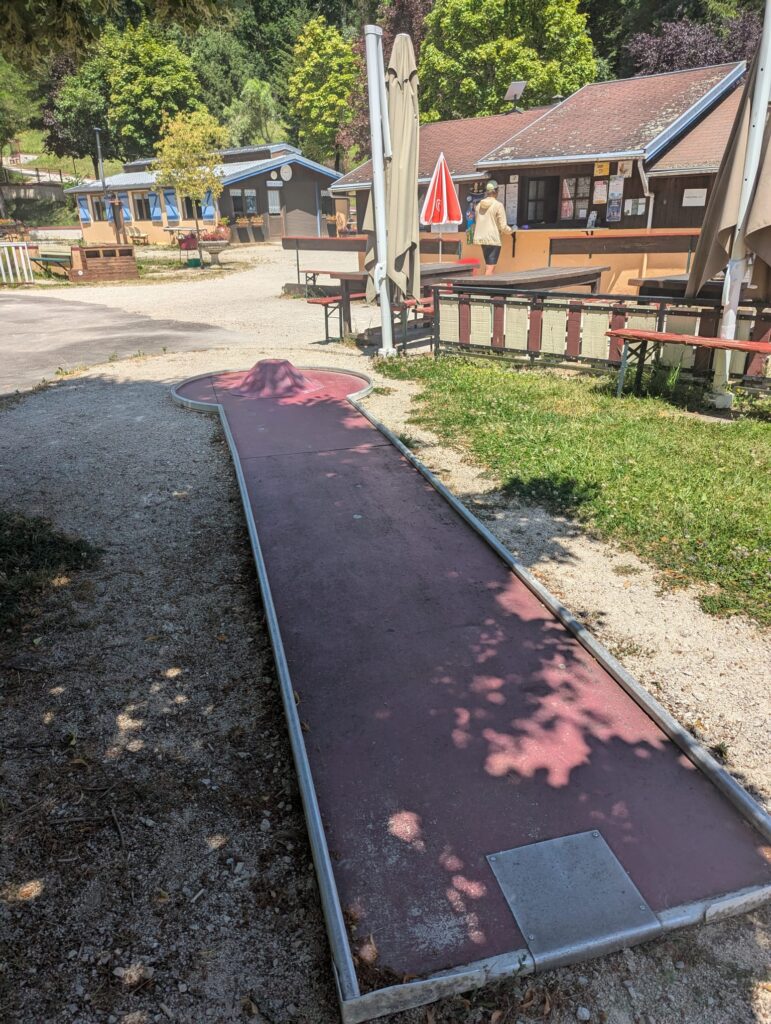
Now, believe me when I tell you: you’ve never experienced the emotion I felt upon entering the Parc de Loisirs de Charmeval. Now, there may well be a coterie of buxom milkmaids splashing around in the ass-cooling pond of my dreams, but if that pond exists, it ain’t here.
Instead, at the concave floor of this balding jungle, this fucking coven of Culicidae, is a small amusement park. Here, dozens of crude loisirs — novelty rides meant for that one deranged child, Roger, you otherwise leave chained to a tire in your basement — wait for a Roger that, it seems, just hasn’t come.
There’s La Mini-Pelleteuse: a fun-sized bulldozer ready to scoop all the mud little Roger can handle. There’s a diamond-plated platform about four feet across with four activey melting Power Wheels bolted in place, waiting to take lil’ Roger for a ride in the round. There’s a sprinkling of sun-bleached, salmon-colored mini-golf holes peeking out under a malarial blanket of dried leaves, and there’s a tiny train track (“Le Sulky-Rail”) snaking around the parc, its train apperently rolled off into the dimension of the pond o’ milkmaids.
One gets the feeling that is more than one clown buried here.
Nevermind all of that, however, as there’s a small concessionaire at the center of it all, throwing a triangle of shade under its sloped roof. I look to Mark for with raised eyebrows. Are we really doing this?
“After you,” he offers with grace.
I poke my head in through the open window. There is a Miko-branded freezer inside — many of the continent’s Cornettos and Magnums are made at the Miko factory in nearby Saint-Dizier, making it the ice cream capital of Europe — but it looks like this cooler’s been unplugged for a decade. “Allo?”

Shirtless and greasy, collarbones jutting out, his head buzzed as if for lice, a teenager appears in the window as if teleported from Birkenau circa 1944. It must be 140 degrees in this little rat trap, and there’s something odd behind those eyes.
“Sorry guys, I was taking inventory,” he says in perfect English. “Can I get you something?”
The menu is mostly what you’d expect from any such place in Asshole, Arizona, with burgers, chicken fingers, fries, and soda. Except for the entrecôte, made from local Hereford cattle, hand-stretched pizza topped with grass-fed goat cheese from nearby Bannes and honey from Palaiseul, plus a proper list of organic wines sourced from Langres.
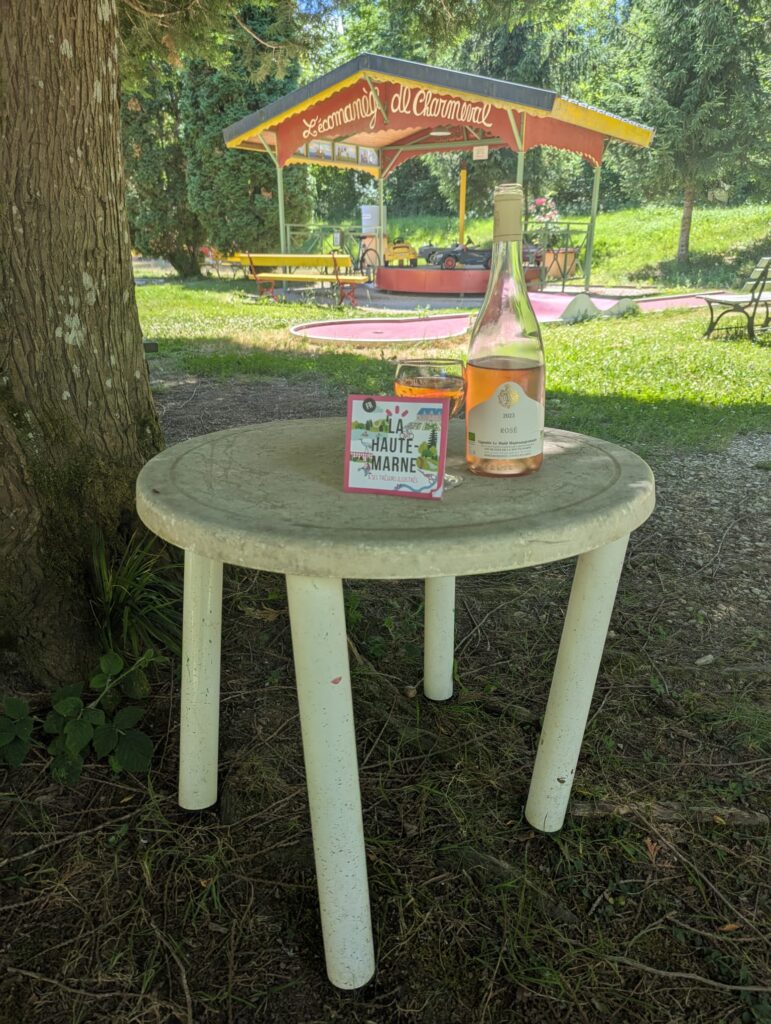
Delirious from the heat, we order a chilled bottle of rose, some steak haché, and the largest water (or Coca-Cola, in Mark’s case) on the menu.
Our host might look like a cast member of an early Harmony Korine film [see: Fig. A], but he couldn’t be more hospitable, presenting us with maps and brochures as if he works for the local tourism board. Our meal, meanwhile, is fresh and caloric, and I’ve got a good buzz going by the time we’re ready to roll ourselves out of this weirdly carnivalian caldera.
My chain slips twice as I promethe my way up this dusty hill, and by the time I hit the main road, Mark is wrapping up a long-distance lover’s quarrel on the phone with a person who will remain nameless.

The sun now begins its descent, lighting the sky with a rosacean hue [see: Fig. B]. We wobble along the barren highway side by side, and rather than unpacking our respective emotional baggage, we engage in everyone’s favorite game of Who Would You Rather: Political Edition. “Tom Cotton or AOC?” “Bernie Sanders or Giorgia Meloni?” “A signed copy of the Geneva Convention or Bob Dole’s rotting corpse?” Normal guy stuff.
Shut Up, Champlitte
We’re staying in Champlitte tonight because I say so, and because it feels funny when I say so. Champlitte. Say it out loud: it’s funny. Champlitte, try it. Say it to your dog. Also: tell your dog I say hello.
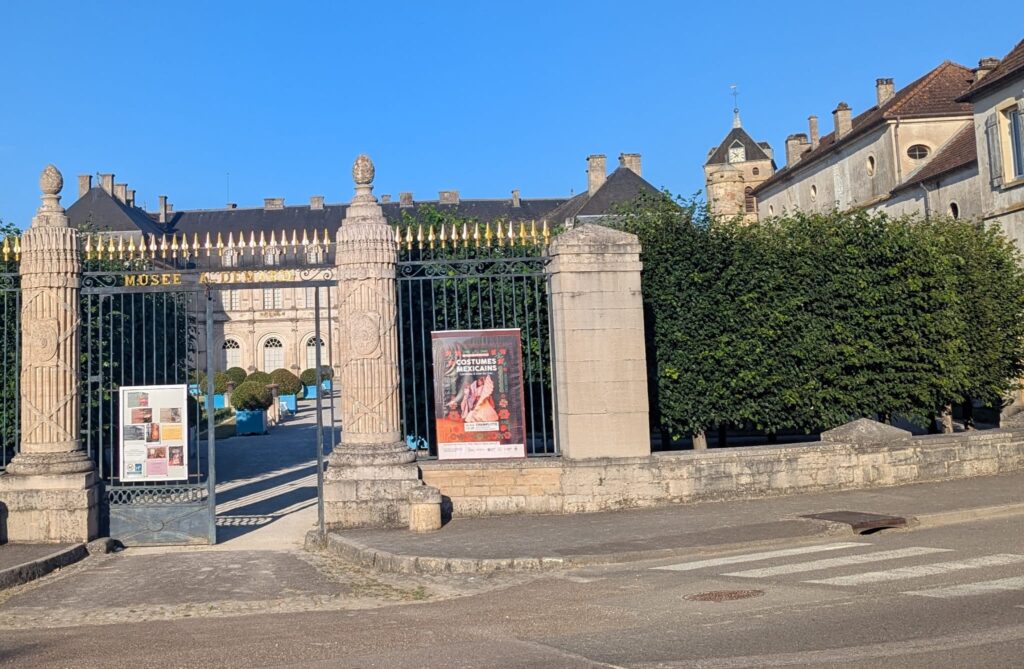
There’s a little guesthouse just beyond the Champlitte city center, which itself is little more than a slender sliver of road surrounding the Château de Champlitte, now home to the Musée Départemental Demard des Arts & Traditions Populaires, plopped against the ruddy sunset on the crest of this little hill just a few miles east of the Côte d’Or.
Founded in the 1950s with the aim of documenting 19th century peasant life — in a massive 16-18th century palace, appropriately enough — it does feature its own little apothecary room, which might’ve been nice chaff for this supposed blog of bitters, but we ain’t got time for no museums.
Having survived the lowlands of the Upper Marne in the region of Grand Est, by making it to Champlitte-la-Ville we’ve officially crossed over into the department of Haute-Saône in the region of Bourgogne-Franche-Comté, and all of those words sound pretty delicious.
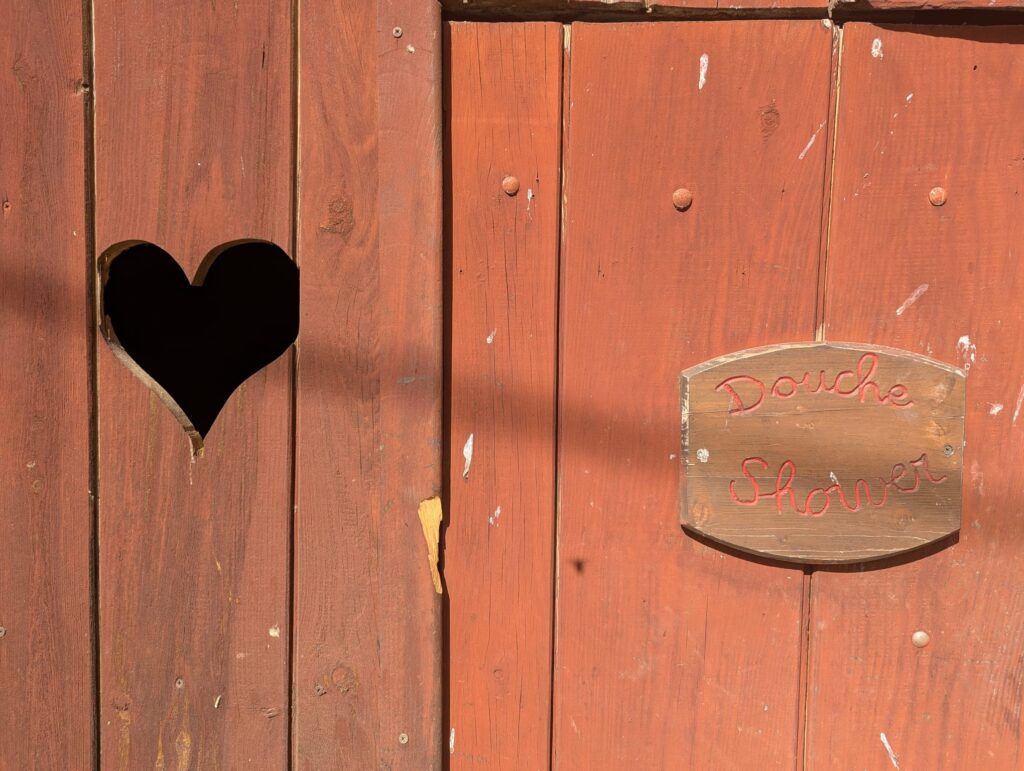
Appropriately enough, then, we check in with our host, a kindly, grizzled old winemaker who helps us hide our bikes in a garage filled enough old world woodworking tools to make Bob Vila jizz his jeans. He brings us to our lodging, a damp, dark space with a small kitchenette and an open-plan shower-shitter bathroom that gives off big-time RV vibes. It’ll do.
As he checks us in, stamping our pilgrim passports with dry, cracked hands which shake subtly from years of toiling in the fields, I try to make small talk, asking how long he’s lived in the area, what he like to do for fun, and so forth.
Mark is not having it. He slams his hand on the table and we both jump.
“Wine,” Mark yells at the man once his bike is locked in the shed. “I want wine!”
“I call my daughter,” the man whimpers. “Please, just don’t heet me.”
“Just shut up and do it already, Jacques Cousteau,” Mark says, throwing an ancient stoneware plates to the ground, shattering it into bits. The man kneels, trying to collect the pieces from under the kitchen table, but Mark kicks him in the gut. “Now, old man!”
As the winemaker backpedals out of the room, shard-bloodied hands shielding his face, I make out a shadow of urine which has pooled in the man’s jeans.
Alone in the silence, I don’t quite know what to say to my friend.
“Looks like somebody’s got a case of the hangries,” I say.
“Booyaaaaaa!” We high five, and I throw another plate to the ground.
“Got eem!”
Mark and I bike back into town to the Carrefour and buy a roast chicken, a bag of weird-ass, half-rotten mâche greens from the clearance section, some chocolate, and approximately 45 single-dose packets of instant coffee.
The cashier is a portly, blonde young woman who refuses to make eye contact with either of us. “That last scene with the winemaker: none of it actually happened, did it,” Mark whispers to me as I swipe my credit card.
“No,” I reply. “Also, most credit cards in France are contactless these days, so even the part where I swipe my credit card was likely fictionalized.”
“This blog entry is already pretty long,” Mark says. “Why are you including all of this?”
“Shut up, Jacques Cousteau,” I shout, and throw another plate to the ground. “Clean up, Aisle 1!”
No, You’re Drunk
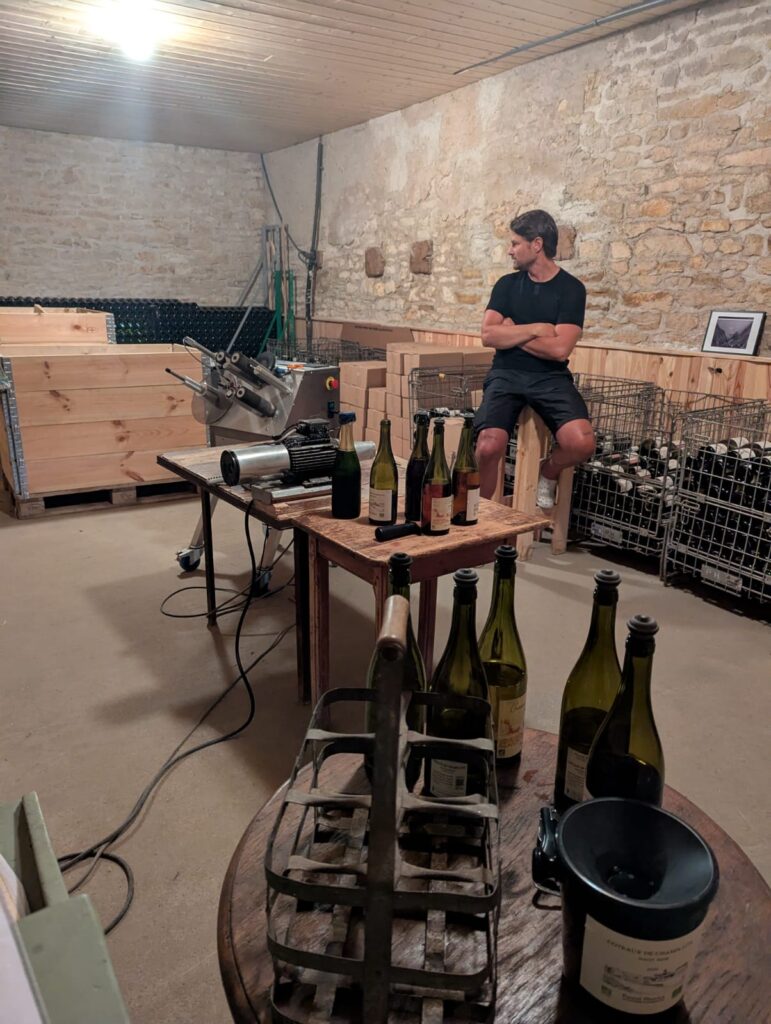
The truth is that we do ask the winemaker for a tasting, and he directs his daughter to meet us in the cave. The problem with this is that the winemaker’s daughter is the most charming, lovely person on earth, and she is hosting us in a room full of wine which she has made with her family and is giving us to taste for free.
Now, you must understand: I am a of both the University of Padua’s Italian Food & Wine master’s program, and an unfulfilled Glancy Wine Education Foundation Scholar. In the realm of wine, I almost really know what I’m talking about, and the only thing more lethal than a mildly qualified, sufficiently drunk Eric talking wine in front of a pretty girl is when it happens in front of a mildly agitated, sufficiently drunk Mark.
Cast in order of appearance:
1) I do my very best to comment thoughtfully on the wine being poured;
2) Mark slams each pour, filming me talk out of my ass in real time as he makes sarcastic rejoinders under his breath, which our host generously ignores;
3) An elderly couple arrives in an RV to purchase some sparkling wine, proclaiming that this region does champagne-style wines better than that region and at half the price, but otherwise ignores every word I, now drunk for the second time today, try to slur back at them in Franch;
3) Having tasted all of the offerings in the room, Mark, knowing I’m desperate to impress our dear host, insists that I pick out my two “favorite” wines. I choose the two I’ve never heard of and struggle to pronounce, including the Artaban, a mid-bodied red which is completely unique to the region.
4) Mark purchases both;
4) We (Mark and I) stagger into our room, dip our hands into the tepid chicken carcass on the counter, and proceed to empty both bottles.
“Hey,” I slur.
“What,” Mark says, his face covered in chicken grease.
“I wanna visit my friend. You down to take a little detour?”
“Where,” Mark says, his face still covered in chicken grease.
“Italian Riviera.”
“Okay.”
“Okay.”
“I’m going to sleep.”
“Okay.”
- Yes, Frank, the French word for plum is prune, which is, in addition to being slang for someone who is a total buzzkill, also the Prunus domestica. This common plum—the variety of which is, in the case of nearly all Californian prunes (and therefore 99% of all plums commercially dried in the United States), are pruned from the Petit d’Agen variety of the Prunus domestica named for an Aquitaine village found some 450 miles southwest of here—is actually a cultivated version of this Ferrari-red, native Prunus cerasifera (“cherry plum”) we ate on this particular turnoff in France.
This cherry plum is not to be confused with the pluerry, which is itself a cross between the Japanese plum (Prunus salicina) and the Prunus avium, the latter of which, though translating directly to “bird plum” from the Latin is actually none other than the common “wild” cherry which is neither wild nor is it the “bird cherry” (Prunus padus), which has both European and Asian varieties; the Himalayan bird-cherry, or Prunus cornuta, is often used as rootstock for those trying to grow Prunus avium in India).
In Russia, the bitter fruit from the European bird cherry is traditionally dried (pruned?), then milled into flour Черемуховая мука, which is the primary ingredient of the Siberian bird-cherry cake. Notably, the author—whose surname is synthetic and does not refer to a familial tradition of milling anything at all—was raised with a Prunus domestica which grew across from the rose bushes in the back yard of his parents’ home on Crabapple Court in West Hills, California. This tree, like all plants which produce plums and cherries—and pears, peaches, almonds, apples, quinces, strawberries, and loquats—was, of course, a member of the same family (Rosaceae) of those neighboring rose bushes, often bore more prunes than the Millmans could handle, and yet in his blissfully ignorant youth, the author was unaware of the kinship between flower and fruit, nor did he ever consider the prospect that one could preserve those prunes through pruning, nor did he ever consider the relevance of the secondary meanings of the word prune itself, which, in modern times, is a verb used to describe what is done by humans to ensure the survival of both plum tree and rose bush and as an ancestor of the word preen, which is what birds do to their feathers to keep themselves looking prim (though it’s worth noting that the primrose is not a rose at all, with the genus Primula relating to the Latin word Primus, referring to its tendency to bloom early). And so, to recap, it is perfectly feasible that a plum-headed parakeet could be found pruning its plumage on the recently-pruned branch of a Prunus padus as Mr. Millman, that old prune, mills the pruned prunes into Черемуховая мука while eating a pruned Petit d’Agen plum. ↩︎