june 25 // spotted dick and owl piss
Hello. We manage to stave off hallucinogenic sleep for the last two hours of our journey, but by the time I reach our destination, Mark is nowhere to be found. More importantly, neither is our lodging.
The Maison-Dieu de Mormant dates back to the early 1100s, offering temporary shelter and spiritual guidance for pilgrims and the destitute well over a century after Sigeric came through.
Established under the Lord of Arc-en-Barrois Hugues Bardoul II of Broyes-Châteauvillain, the “God House” of Mormant was already facing hard times by the end of the 13thcentury, when Pope Boniface VIII transferred control of these grounds to the Poor Fellow-Soldiers of Christ and of the Temple of Solomon1.

Notably, given that 2025 is the year of the Jubilee, Boniface launched the first in 1300, inspiring an estimated two million pilgrims to journey to Rome on this route that year alone.
Before we associate what we now call the Francigena with modern-day France, I should note that it was Boniface’s beef with the King of France, King Philip IV2, which would undermine the spiritual value of the pilgrimage for centuries.
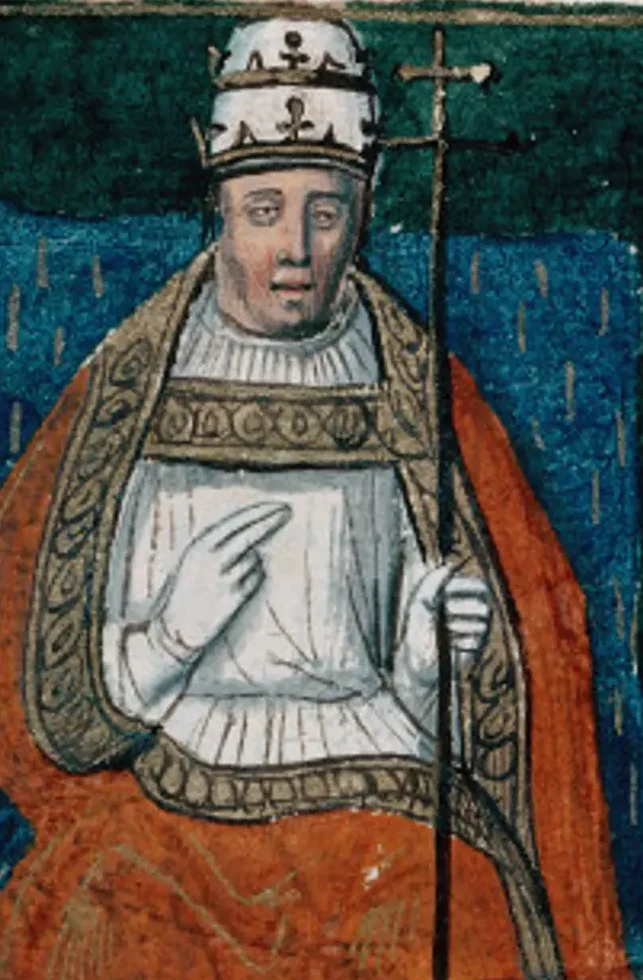
In fact, Boniface’s hubris was so extraordinary (even for a Pope during the late Middle Ages) as to have changed European history forever, resulting in Dante’s exile, the dissolution of Rome as the seat of the papacy, and least of all, with the Slap of Agnani3, his own downfall.
Boniface’s successor, Pope Clement V — a childhood friend of Philip — changed the tides significantly in favor of the Crown, moving the seat of the papacy to Avignon while accusing the Templars of anything from heresy to sodomy. As hundreds of Templars were arrested and/or executed, control of the Maison-Dieu was transferred to the Knights Hospitaller, who ran the hospital until the French Revolution when, as we now know, basically all religious institutions were shuttered.
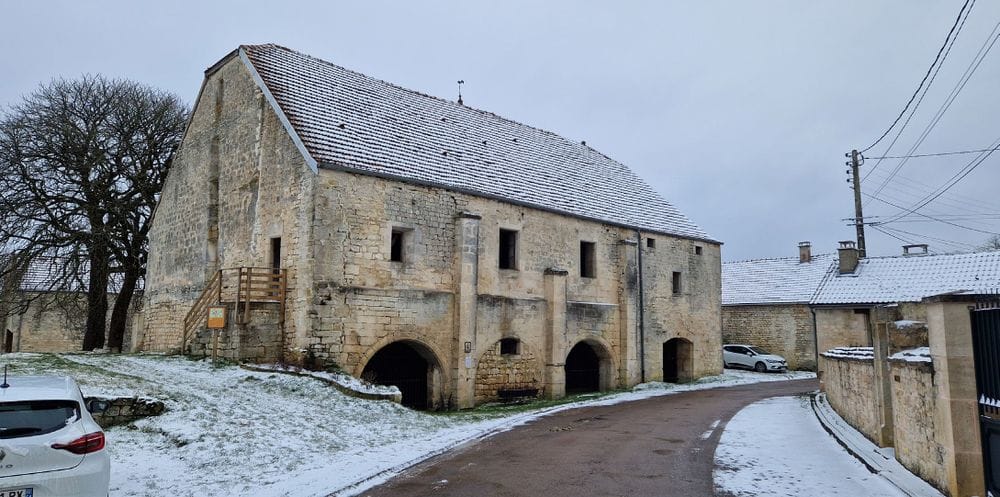
So no, I suppose the reservations we made for tonight are not for that pile of bricks on my left. Nor are they for that grain silo just behind it, or for that shed full of tractors across the gravel.
Reaching the end of the road, there’s a lonely dog chained to a mammoth cherry tree casting shade over a farmhouse that looks like the set of a Wes Craven film. Nevertheless, I knock on the screen door. “Bonjour? Allo?” Nothing and no one. Shit.
The dog sits at attention in a patch of shade, seemingly doing everything in his power not to look at me. “Where is everyone, dog?” He does not answer.
I set my bike on the ground and try to approach him, but proving himself to be altogether unworthy of the love I want to give him, he barks, jumping and pulling at his chain. And they say I’m crazy.
Getting down on all fours, my head lowered in deference, knees squishing fallen cherries on the gravel, I inch closer to the dog, trying to shush and placate it into loving me. “Chut chut, mon petit,” I whisper, holding out my paw. “Je suis un amis.”
“Ereek Meelman?” An elderly lady, her hair as brown, patchy, and matted as the dog’s, stands at the mouth of the dirt path. “Il est là! Hee eez ‘ere,” she yells down the road, and in a moment Mark appears as well.
“I’ve texted you like ten times,” Mark says. “You’ve got cash, right?”
I shrug. Probably.
“OK,” he says. “Get your shit and let’s go.”
And without giving that dog another thought, I leave him right he belongs: alone to eat my (anastomotic) farts in the setting sun. I didn’t even like him.
\\
Rather than the medieval holy house I was expecting, our night’s lodgings at the Maison-Dieu Part Deux are in a thoroughly modern two-story home with double-pane windows and vinyl siding that, unlike that last house on the left, looks like a runaway from suburban Texas.
Leaving my bike to cool down in the adjacent barn, I feel my way through the darkness into a courtyard where a line of fat, shiny black ants have been marching directly into Mark’s bag (Mormant? More like morants, ja? #basketballreference #formicidaepuns). He scrambles to deal with that whole situation while I glide into the first real A/C I’ve felt in a month.
There’s a pair of wicker chairs which straddle a sofa. On the couch, a succulent, wispy older couple. Their smiles reflect on the dead black of the big screen TV. They look as if they were expecting me.
“Not bad, eh?”
The man is bronze with slightest bit of gray streaked in his hair. His brow is prominent and he is dressed in an enviably cool-looking linen shirt. He enunciates his words with a crisp, relaxed brogue, as if he were a BBC correspondent reporting from some tropical island in Ireland.
“I’m Liam, and this is my wife, Georgie,” he says, offering a firm handshake.
Georgie is a sinewy blonde with kind, puffy eyes, presenting with a disconcerting ease in her flowing sun dress. She unfolds her legs from the crude taffeta cushion, offering her hand with a smile that would’ve absolutely liquefied that goddamned dog. “So nice to meet you,” she says in upper-crust English.
“Me Eric,” I belch in thousand-ton, middle-class American.
“Lovely,” she says without the slightest hint of irony. “And you’re traveling with Mark, then? How nice.”
Our matron blasts into the room asking for my pilgrim passport, then hands me a laminated packet of house rules as she handwrites our bill.
“Crisis averted,” Mark notes, click-clacking in through the open door, his cycling shoes like spurs on the white ceramic tile.
“She asked if we wanted dinner. I told her you’d pay,” Mark says, plopping on a chair. “But you should ask her about, you know…” he says, nodding the large bottles of La Choue4 lined up on the kitchen counter. Oh great, just another couple of crude yankees looking to boof whatever swill comes their way.
“Eric, if it’s not too much trouble,” Liam interjects, “would you add a bottle for us? And put them all on our tab.”
“No trouble at all, Liam.” (Translating for booze…why can’t that be a job?)
After a quick trip upstairs to shower, then unpack my bag and my bowels, I find our new British friends setting a table already populated with a few pots and platters hidden under foil.
“Ah, there he is,” Liam says, wagging a bottle. “May I?”
“You may,” I say, grabbing a jug of water from the fridge for the table. Mark takes a break from his phone, where he presumably watches compilations of children falling down the stairs, to grab some glasses from the the sink.

The ale is dark, rich, pruney and, as is mercifully standard out here, quite strong. Lurking under the foil, our meal is grated carrot salad, crusty bread, and a fat pot of lentils with andouillette, the latter of which Liam ladles out in generous scoops. “Our dear Georgie is vegetarian. Might I, er, split her sausage between you gents? That is, ha ha, as it were.”
Liam (Irish-English) and Georgie (English-English) have spent the last month or two walking directly from their Wimbledon home to this spot. They might be the first people we’ve met with their sights on Rome, though if there’s any religious impulse between them, they haven’t shown it.
Georgie, a retired special needs teacher, wants to spend the summer making use of the Italian classes she’d been taking. Liam, a palliative care physician and professor on the verge of retirement, is, after after a lifetime spent helping people die, simply here for a challenge.
They are, to put it simply, better people than we are. Skilled in the art of Acting Interested In You while peppering the pot with a few modest anecdotes of their own selfless accomplishments, they are each self-deprecating, yet they manage to keep things positive at all costs.
As Liam doles out scoops of desert, a dense, spicy, sticky pudding similar to spotted dick, I indulge in tales of my own struggle as a poor, quasi-geriatric writer living in L’America. Georgie literally cradles her heart in her hand with absolute compassion, noting that while she can’t quite relate herself, given the good fortune she’s had in life, she does a certain generational divide as her own daughter struggles to follow in her footsteps as a teacher with no choice but to spend her summer at home.
Liam, pouring out a freshly cracked bottle of blanche, bemoans just how wide the class divide has grown in recent years, going so far as to spit on the memory of Margaret Thatcher, that old soggy prune.
I feel my face growing flush, as each of my fallback pseudo-socialist talking points are thoughtfully received and rejoindered. In no other universe would I ever find myself sharing a table with such accomplished, utterly unhateable people as a peer.
Liam takes the lead on dishes, Mark dries, Georgie wipes down the table, and I finish off the last of the beer, trading a few last stories from the trail. It’s just about dark out and Liam wrings out the sponge. “Right. Boys, it’s been great,” he sighs, offering his hand for one last shake, “but it’s bonne nuit for us.”
Upstairs, I wash my clothes with the house’s hand soap, deposit more of yesterday’s cheese into its plumbing, and stare out of the leaded window onto the plain, craning my ear for that familiar canine yelp. Nothing but nothing.
I love this fucking trail.
- Better known as the Knights Templar, the Fellow-Soldiers were a militant group — Medieval Oath Keepers, you might say — founded to protect pilgrims on their way to Jerusalem. ↩︎
- The King of France from 1285-1314, Philip IV is remembered as remarkably handsome and merciless, earning himself nicknames like the “Philip the Beautiful” and the “Iron King.” ↩︎
- Named for the Pope’s sanctum just east of Rome, the “Schiaffo di Agnagni” was the apex of Boniface’s long-running feud with the King and, by extension, the powerful Colonna Family, who robbed the Pope’s nephew of the Pope’s gold in 1301.
In turn, the pope excommunicated several powerful members of the Colonna Family, and by 1303, since he was a member of the White Guelphs, who also advocated for independence from the pope, Dante himself.
The struggle for power was so extreme that in that same year, Boniface was preparing to excommunicate the King. Unfortunately for Boniface, that autumn, a group of 1,600 King-friendly militants flooded the gates of Agnani, the Pope’s sanctum just east of Rome. Led by Sciarra Colonna, the rebels beat the Pope in his boniface so thoroughly that he was dead within a month. ↩︎ - This is seemingly the most predominant ale in the region (not to be confused with Belgiam’s La Chouffe). Does choue mean both owl and cabbage in this language? And if so, why the fuck? ↩︎